
Engineers and Supervisors: The Lean Partnership That Drives Change
Engineers and Supervisors: The Lean Partnership That Drives Change Introduction: Why Lean Succeeds or Fails at the Engineer–Supervisor Interface In most organisations, engineers and supervisors work closely—but not always effectively. Engineers are often tasked with designing better systems, optimising processes, and solving technical problems. Supervisors are responsible for executing daily
The Role of a Team Sponsor: Leadership That Removes Roadblocks
The Role of a Team Sponsor: Leadership That Removes Roadblocks Introduction: Why Most Improvement Teams Stall at Leadership In many organizations, continuous improvement initiatives begin with enthusiasm and momentum—yet slow down once genuine obstacles emerge. Teams identify issues clearly, suggest practical solutions, and even test improvements, but progress halts when
Building Your PIT Crew: How to Form a Cross-Functional Improvement Team
Building Your PIT Crew: How to Form a Cross-Functional Improvement Team Introduction: Why Improvement Fails Without the Right Team Most continuous improvement efforts do not fail because of poor tools or weak ideas. They fail because the wrong people are involved — or worse, key people are missing entirely. The
Why Continuous Improvement Fails Without Measurable Goals
Why Continuous Improvement Fails Without Measurable Goals Introduction: When Improvement Effort Doesn’t Lead to Results Many organizations think they are engaging in continuous improvement. Teams participate in workshops, leaders promote ideas, and improvement tasks are listed on schedules and boards. However, over time, enthusiasm diminishes and progress stalls. When leaders
Profitability and Productivity: The Two Metrics That Drive Growth
Profitability and Productivity: The Two Metrics That Drive Growth Introduction: Why Growth Is Often Misunderstood Many organizations pursue growth by increasing volume, customers, or complexity before establishing the necessary systems to support it. Revenue rises, but margins decrease. Workloads grow, but results remain stagnant. Teams become busier without improving. Growth,
Choosing Your First Process To Improve — Where to Begin
Choosing Your First Process To Improve — Where to Begin Introduction: Why Most Improvement Efforts Start in the Wrong Place When organizations decide to begin a continuous improvement journey, one of the first questions they ask is deceptively simple: Where should we start? Unfortunately, this question is often answered emotionally
The TIMWOODS Method: How to Spot the 8 Types of Waste
The TIMWOODS Method: How to Spot the 8 Types of Waste Introduction: Why Waste Is Harder to See Than It Should Be Most organizations agree that waste is part of their processes. The challenge is seeing it clearly and defining what exactly counts as waste. Over time, inefficiencies become normalised.
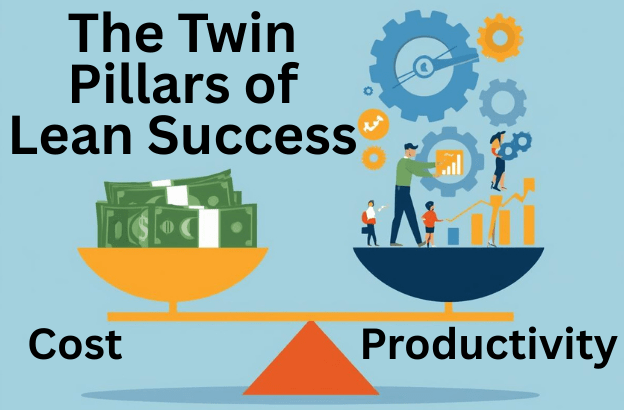
Cost and Productivity: The Twin Pillars of Lean Success
Cost and Productivity: The Twin Pillars of Lean Success Introduction: Why Cost and Productivity Cannot Be Improved Separately Many organizations claim they want lower costs and higher productivity, yet their improvement efforts unintentionally pit the two against each other. Cost reduction initiatives often focus on labour cuts, tighter budgets, or
The Customer’s Clock: Understanding Delivery as a Lean Metric
The Customer’s Clock: Understanding Delivery as a Lean Metric Introduction: Customers Do Not Measure Effort — They Measure Time Most organisations discuss delivery based on planning, scheduling, or logistics performance. Teams focus on labour availability, supplier delays, staffing shortages, and forecast accuracy. However, for customers, the experience is much simpler:
Quality as Culture: Why It’s Everyone’s Job
Quality as Culture: Why It’s Everyone’s Job Introduction: When Quality Is Treated as a Department, It Fails In many organizations, quality is still seen as a role held by inspectors, auditors, or a specific department. This mindset unintentionally creates a gap between those doing the work and the responsibility for
Why Safety Is the Starting Point for Every Continuous Improvement Project
Why Safety Is the Starting Point for Every Continuous Improvement Project Introduction — The Improvement Shortcut That Always Backfires When organizations initiate a continuous improvement effort, the pressure to deliver results is immediate. Leaders feel compelled to enhance efficiency, cut labour costs, and boost output quickly. Safety is often recognized,
Lean in Numbers: Translating Key Performance Indicators (KPI) Improvements into Cultural Wins
Lean in Numbers: Translating Key Performance Indicators (KPI) Improvements into Cultural Wins Introduction — When the Numbers Change, Something Deeper Is Happening Leaders often speak about culture as if it’s intangible—something you can sense but not quantify. KPIs, however, are regarded as concrete facts: percentages, charts, and calculations that appear
Capturing Staff Improvement Ideas Effectively
Capturing Staff Improvement Ideas Effectively Introduction — Why the Best Improvement Ideas Rarely Come from Management Most organizations say they want employee engagement. Far fewer know how to capture it effectively. In many factories, staff are full of ideas—but they stop sharing them. Not because they don’t care, but because
Process Walk Improvement Ideas
Process Walk Improvement Ideas Introduction — Why Most Improvements Start in the Wrong Place Many improvement efforts begin in a conference room. Teams gather around spreadsheets, reports, and dashboards. They debate numbers, argue about causes, and brainstorm solutions—often without ever seeing the work as it actually happens. While these discussions

Building a Lean Case Study: How to Document Success in Your Factory
Building a Lean Case Study: How to Document Success in Your Factory Introduction — Why Most Improvements Are Forgotten Many factories improve. Far fewer factories prove they have improved. Teams reduce lead time, improve flow, eliminate waste, or stabilize quality—but six months later, the gains quietly fade. New leaders arrive.
Why Visual Management Is More Than Signs on the Wall
Why Visual Management Is More Than Signs on the Wall Introduction Visual management is one of the most misunderstood elements of Lean. Many organizations reduce it to posters, colourful charts, or digital dashboards that look impressiv but fail to influence behaviour. In Efficient: The Proven Steps to Reduce Waste and
Key Performance Indicators (KPI) Transformation: Tracking What Really Matters
Key Performance Indicator (KPI) Transformation: Tracking What Really Matters Introduction — Why KPIs Often Fail to Improve Performance Most businesses monitor KPIs, but fewer utilise them effectively. Walk into a manufacturing plant or service operation, and you’ll often hear leadership say, “We review our KPIs every week.” Yet the same
Why Implement 5S
Why Implement 5S Introduction In today’s fast-paced, cost-sensitive business climate, efficiency and organization are no longer optional—they\’re crucial. The 5S system—Sort, Set in Order, Shine, Standardize, and Sustain—is a foundational strategy in lean thinking. Implementing 5S offers tangible benefits: an organized workspace, drastic waste reduction, improved process flows, enhanced safety,
The 5 Lean Principles
The 5 Lean Principles: Building a Culture of Continuous Improvement Discover the five Lean principles that drive lasting efficiency, eliminate waste, and build stronger teams. Learn how managers can apply Lean thinking to create flow, focus on customer value, and foster continuous improvement — without cutting people. Why the 5
What Is Lean, Really?
What Is Lean, Really? Most people think Lean is about cutting costs. It’s not. Lean is about maximizing value while minimizing waste. It’s about making work flow smoothly — so people can do their best work without frustration and wasting time. Think of it this way: if a process wastes